Telehealth is no longer an emergency workaround. For millions of patients, it’s the default. Across outpatient care, follow-up visits are routinely scheduled as video unless someone specifically requests otherwise. For many patients, that shift has been a net positive — less travel, more flexibility, easier access to specialists.
But as telehealth has become the standard mode of care delivery, health systems haven’t always updated their language access programs to match. For the roughly 26 million people in the United States with limited English proficiency, the gap between how care is delivered and how language access is structured creates real problems — not because remote interpretation doesn’t work, but because the programs around it weren’t designed for a telehealth-first environment.
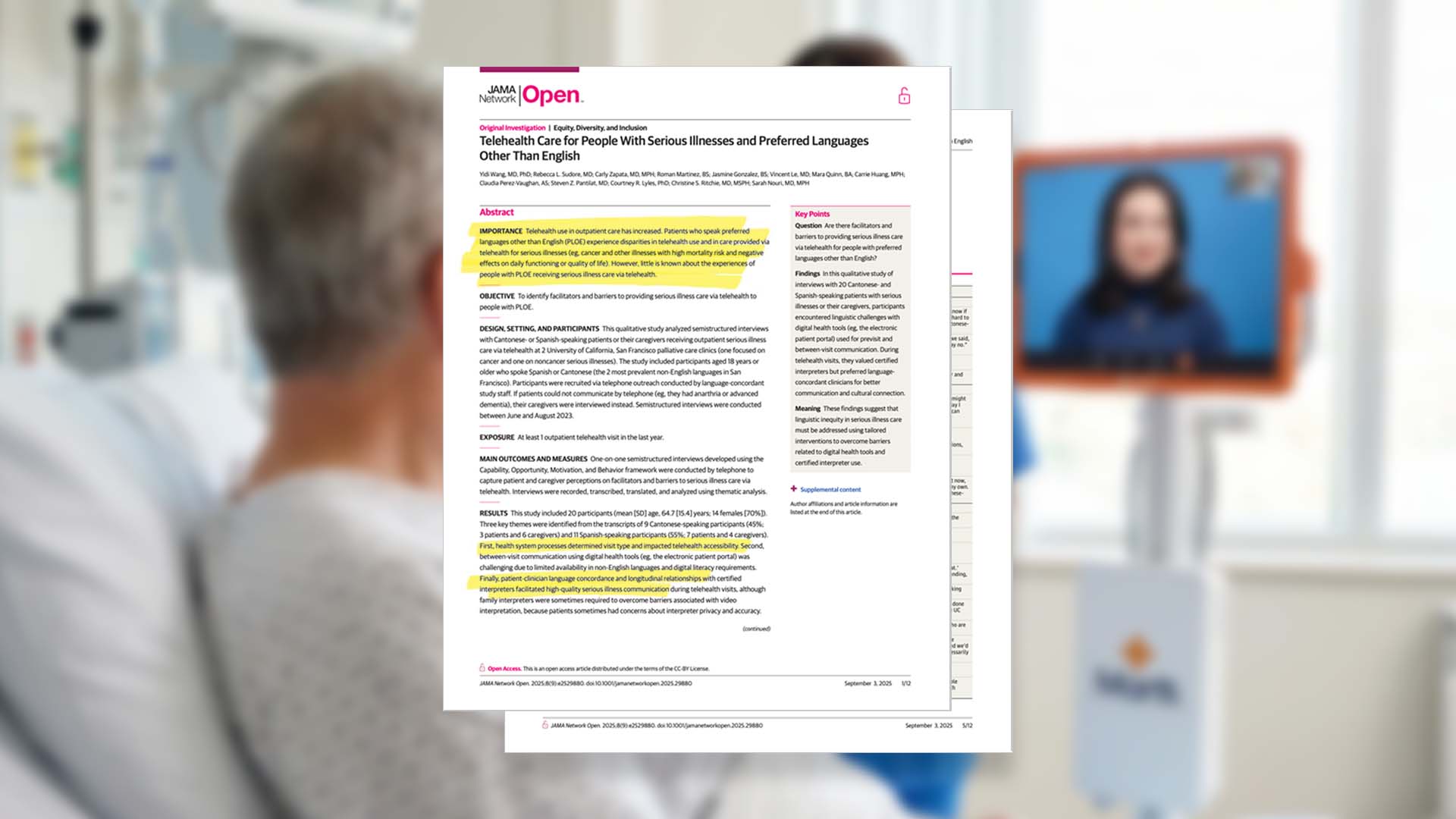
A qualitative study published in JAMA Network Open by researchers at the University of California, San Francisco examined the experiences of Cantonese- and Spanish-speaking patients with serious illnesses — including cancer and other high-mortality conditions — receiving care via telehealth. The findings point not to a failure of remote interpretation as a modality, but to specific, addressable gaps in how health systems design and operate their language access programs.
The Problem Isn’t the Interpreter. It’s the Program.
Remote medical interpretation is a critical component of any effective language access program. It extends reach, ensures coverage across languages, and makes specialist care accessible to patients who would otherwise face significant barriers. The question this study raises is not whether remote interpretation should be part of the model. It’s whether health systems have built programs that set interpreters — and patients — up to succeed.
The UCSF researchers describe how structural gaps in virtual-care language access can show up in specific, predictable ways.
Interpreter continuity matters for patient trust — especially in sensitive clinical settings. Participants drew a clear distinction between interpreters they’d worked with over multiple visits and those they encountered for the first time. With familiar interpreters, patients felt comfortable discussing symptoms, fears, and goals of care. With unfamiliar ones, they had concerns about privacy and rapport. In palliative and oncology contexts — where conversations involve prognosis, treatment decisions, and end-of-life planning — that comfort directly shapes what patients are willing to disclose. This comes down to program design: does the system support continuity, or does each encounter function like a one-off?
Interpreter qualifications determine the quality of the clinical encounter. Participants described variability in accuracy, difficulty with medical terminology, and challenges accommodating hearing differences and regional accents. The researchers note that these findings align with prior studies documenting clinically significant interpretation errors in serious illness communication. Across these accounts, interpreter training and clinical readiness consistently shape the experience. By relying on medically qualified professionals with ongoing training and quality oversight, programs prevent introducing variability that has real clinical consequences.
When programs don’t meet the standard, workarounds fill the gap. Some participants described family members stepping in to interpret — not because they preferred it, but because the alternative wasn’t meeting their needs. The study’s authors flag this as concerning, citing evidence that ad hoc interpreters are associated with worse prognostic understanding, content omission, and caregiver burden. This is a signal that the program has a gap. When language access is delivered by qualified medical interpreters through well-structured workflows, the pressure for ad hoc workarounds diminishes. Effective programs reduce the need for families to fill a role they were never meant to play.
Language Access Is Bigger Than the Visit
One of the study’s most instructive findings is how much of the communication challenge happens outside the clinical encounter. Patients couldn’t effectively navigate patient portals because they weren’t available in their preferred language. Appointment confirmations, pre-visit instructions, and between-visit messaging—the connective tissue of modern outpatient care — were functionally inaccessible.
The downstream effect was significant. Patients defaulted to whatever visit type was scheduled for them without voicing preferences or concerns. The researchers noted that this passivity was unique to non-English-speaking participants — English-speaking patients in the same cohort did not describe this experience.
This broader view is also reflected in the SPEAK Act, now law, which directs U.S. Department of Health and Human Services to issue guidance on language access best practices in telemedicine and related health information technology, including patient portals, multilingual communications, interpreter integration, and multi-person video support.
This is worth noting, because it reframes the scope of the challenge. Language access is often conceived as a during-visit service: connect an interpreter when the patient and provider are talking. But communication in healthcare is continuous. It starts with scheduling, runs through pre-visit preparation, extends into the encounter, and continues with follow-up instructions and ongoing messaging. The most effective language access programs treat the full arc of that communication as their responsibility, not just the minutes when a clinician is on screen.
What Effective Programs Get Right
The UCSF researchers offer recommendations that, taken together, describe what a well-designed language access program looks like in a telehealth environment.
Healthcare-specialized interpreters as the standard, not the exception. The quality concerns in this study trace directly to interpreter training and qualification. General-purpose interpreter pools—where interpreters serve multiple industries and may lack healthcare-specific training—introduce variability that affects accuracy, encounter length, and patient trust. Programs built around medically qualified interpreters with structured training in clinical terminology, ethics, and cultural competence produce a fundamentally different experience.
Interpretation integrated into clinical workflows, not added as a separate step. When accessing an interpreter requires a separate platform, a separate dial-in, or a separate scheduling step, every link in that chain is a point where access can break down. Effective programs embed interpretation into the systems clinicians and patients already use—the EHR, the telehealth platform, the point of care—so that language access is part of the workflow, not a disruption to it.
Systems that support continuity and quality governance. The study’s finding about interpreter familiarity speaks to a broader design principle: effective language access isn’t just about connecting any interpreter. It’s about building systems with quality assurance, structured feedback, and the operational infrastructure to deliver consistent, high-quality interpretation across every encounter. Programs that invest in this governance layer create the conditions for trust and accuracy that patients in this study were seeking.
Visit structures that account for the reality of interpreted encounters. Interpretation takes time. Pre-briefs between clinicians and interpreters improve quality. Debriefs help ensure nothing was lost. When visit schedules don’t account for this, either the interpretation is rushed or the clinical conversation is compressed. Effective programs build this into scheduling and workflow design rather than treating it as an inconvenient add-on.
A comprehensive view that extends beyond the encounter. The strongest language access programs consider the full patient experience — scheduling, portal navigation, pre-visit communication, post-visit follow-up — and build solutions that address communication at every point where language barriers can create confusion, delay, or disengagement.
A Consistent Direction in the Research
This theme shows up in other research as well. Earlier this year, a randomized clinical trial examining remote interpretation for Deaf patients reached a similar conclusion: interpreter training and quality governance are important factors in whether remote interpretation delivers on its promise — not the technology itself. [Read our analysis of that study here.]
Across these studies, a consistent picture is emerging. Remote interpretation is an essential capability for modern healthcare. The technology to deliver it is mature. What separates programs that work from programs that don’t is how they’re designed: the qualifications of the interpreters, the depth of workflow integration, the investment in quality governance, and the willingness to treat language access as a clinical capability rather than a compliance-only checkbox.
Questions Worth Asking About Your Program
For health system leaders evaluating how their language access programs perform in a telehealth environment, this research points to a few critical areas of inquiry.
Are your interpreters trained specifically for healthcare? The UCSF researchers found quality variability even within a well-resourced academic health system. Interpreter qualifications — medical terminology, clinical ethics, ongoing quality assurance — should be evaluated with the same rigor as any other clinical resource.
Is interpretation embedded in your telehealth workflow, or does it require separate steps? Every additional step — a separate link, a phone number, a scheduling process—is a point where access can fail, especially for patients with limited digital literacy.
Does your program support quality governance and consistency? Structured quality assurance, interpreter training standards, and operational accountability create the conditions for the trust and accuracy that patients in this study valued most. Programs without this infrastructure are more likely to see the variability the researchers describe.
Does language access extend beyond the visit? Yes. If patients can’t navigate scheduling, read portal messages or your website, or understand pre-visit instructions in their preferred language, even excellent in-visit interpretation is solving only part of the problem.
How do your remote and onsite interpreter resources work together? The strongest language access programs combine onsite interpreters for contexts where physical presence matters with remote medical interpretation that ensures coverage, speed, and consistency across all encounters and languages. Neither modality replaces the other. The program design determines how they complement and champion each other.
The Standard Is Within Reach
Telehealth has reshaped how care is delivered. Language access programs need to be designed for that reality — not simply carried over from an onsite model that assumed the interpreter would always be in the room.
The patients in this study wanted what every patient wants: to understand their care, communicate their concerns, and feel confident that what they said was accurately conveyed. To meet that standard for patients with language access needs in telehealth, health systems need language access programs designed for virtual care. That includes clinically trained interpreters, workflow integration that makes interpreter access seamless, quality governance that supports consistency across encounters, and training that prepares care teams to handle the technology virtual care depends on. When those elements are built into the program, remote interpretation becomes a reliable clinical capability across visits, settings, and languages.
The research is clear on what works. The tools exist. The question is whether health systems are willing to build their programs accordingly.
Study Reference
Wang Y, Sudore RL, Zapata C, et al. Telehealth Care for People With Serious Illnesses and Preferred Languages Other Than English. JAMA Network Open. 2025;8(9):e2529880. doi:10.1001/jamanetworkopen.2025.29880
About the Author