
When a parent brings their child to the hospital, they have to process a lot all at once. They may be worried about what is wrong, trying to comfort their child and listening carefully as clinicians explain what happens next. If that parent needs an interpreter, having reliable language support can make it easier for them to focus on what matters most: their child.
And that need does not end after the first conversation.
As a child moves through care, their family will meet new faces, receive lots of information and eventually be discharged to continue care at home. A parent who had questions at admission may have entirely different ones by discharge: When should I give this medication? What’s the right dose? Is it safe? When can my child go back to school? Who do I call if something changes tomorrow? What are the danger signs I should look out for?
A strong language access plan anticipates those moments. It helps staff know what a family needs for each conversation and helps parents participate in their child's care with ongoing language support alongside them.
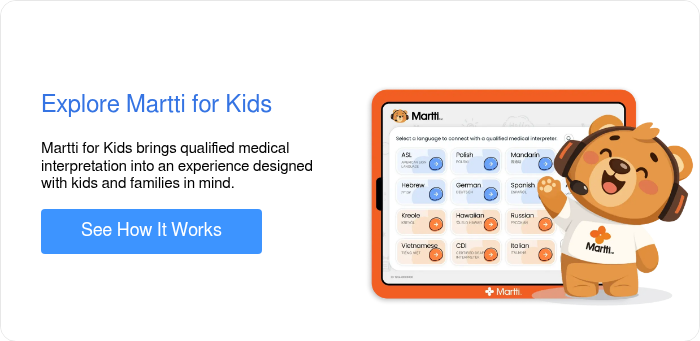
For pediatric patients, we can go one step further. Martti for Kids brings a kid-friendly experience to interpreter encounters, helping care teams support communication with both the child and the parent.
Support the whole family, not just the patient
Consider an English-speaking child whose parent needs an interpreter. A clinician may be able to speak directly with the child, but they still need interpretation so they can understand the parent's description of symptoms, explain a treatment decision or talk through what the family will need to do at home.
If the care team only records the child's preferred language, the next clinician may not know that the parent needs an interpreter. That can create unnecessary work for staff and put the burden back on the family to explain their needs.
Instead, language access planning should consider everyone participating in the patient’s care, including caregivers whose communication needs differ from the patients.
Good continuous care means each part of the care team has the information they need to continue the conversation. Staff should know where to find the family's language needs, how to access appropriate support and where to turn when the usual approach does not fit the encounter.
Working through these handoffs with the staff who use them can reveal where families or care teams are hitting obstacles. It also gives healthcare organizations and their language access partners the opportunity to make the experience more connected from one conversation to the next.
Make the experience work for the child, too
While a parent is trying to understand a diagnosis or medication schedule, their child is having an experience of their own. They may be nervous about an unfamiliar environment, wondering when they can go home or thinking about whether they will be able to return to school.
Language access in pediatrics should address both experiences.
Martti for Kids gives special attention to how an interpreter encounter feels to a young patient. The pediatric experience within Martti uses child-friendly screens and animation around the interpreter call while preserving the clinical workflows care teams use. Children's hospitals and families helped shape the experience, and organizations can enable it in the facilities or departments where it is needed.
That means staff can continue using the trusted, familiar interpretation workflow that supports the family's communication needs while giving children an experience created with them in mind.
Prepare parents for the questions that come after discharge
Discharge is one of the clearest examples of why language access needs to follow a family throughout care.
A parent may leave with medication instructions, follow-up appointments and guidance about what to watch for at home. Before they walk out the door, they need an opportunity to understand those instructions, ask questions, and talk through how the plan will work for their family.
For a parent who needs an interpreter, qualified language support needs to be part of that conversation. Written discharge instructions in the right language give the family something to refer to later, while the discussion itself gives parents an opportunity to ask questions specific to their child or circumstances.
The child still needs to be part of that experience, too. While a parent works through the details of care at home, clinicians can help the child understand what comes next in a way they can follow.
And communication should not stop when the family leaves the building.
If that parent wakes up the next morning with a question about a medication or a change in symptoms, they should know who to contact and that language support will be available during that conversation. Making that pathway clear before discharge can help the parent know where to turn when questions arise at home.
Build language access around the family's journey
When I talk with healthcare organizations about pediatric language access, I would not look at Martti for Kids as an isolated experience. I would look at the entire journey around it.
Does every member of the care team know that the patient or the parent needs an interpreter? Can staff easily access interpreters? Does the child have an experience that feels appropriate for them? When the family goes home, do they know how to reconnect with the care team and access language support when another question comes up?
Those pieces work together.
A strong language access plan gives staff a clearer path for supporting the family from one encounter to the next. For parents, it means spending less time figuring out how to access interpretation and more time participating in their child's care. And with Martti for Kids, organizations can consider the experience of the child alongside the communication needs of the adults caring for them.
Learn about enabling Martti for Kids.
FAQs
What is medical interpretation?
Medical interpretation is the real-time interpretation of spoken or signed communication between a patient and their care team by a trained professional. It differs from general interpretation in what it requires: medical terminology, patient privacy training, and cultural competency, so that symptoms, diagnoses, and consent are conveyed accurately rather than approximately.
Does Section 1557 of the Affordable Care Act require interpreter services?
Yes. Section 1557 requires covered health programs to take reasonable steps to provide meaningful access for patients with limited English proficiency, including qualified interpreters at no cost to the patient. It also restricts relying on family members or minors to interpret, except in narrow emergency circumstances.
What is video remote interpreting in healthcare?
Video remote interpreting connects a patient and clinician to a live interpreter over video, from a tablet, cart, phone, or computer at the bedside. Video preserves facial expressions and gestures that phone interpretation loses, which especially matters in pediatrics, where a young patient's reaction is often part of the information.
How do hospitals provide interpreter services?
Most health systems combine on-site interpreters for planned, complex encounters with video and phone interpretation for immediate and less common language needs. Increasingly that access is launched from within the EHR, so clinicians connect without leaving the chart and each session is documented automatically.
About the Author